✓ ECG Checklist
Glasgow Paediatric ECG Systematic Review - answer YES if finding is normal
Patient Context
YES = normal. NO = abnormal - discuss with senior / cardiology.
Rate
Is the heart rate appropriate for the age of the child?
Enter patient age above to see the normal HR range.
Rate abnormal for age. Consider: sinus tachycardia (fever, pain, shock, SVT), sinus bradycardia (raised ICP, heart block, hypothyroidism, medication). Discuss with senior / cardiology.
Rhythm
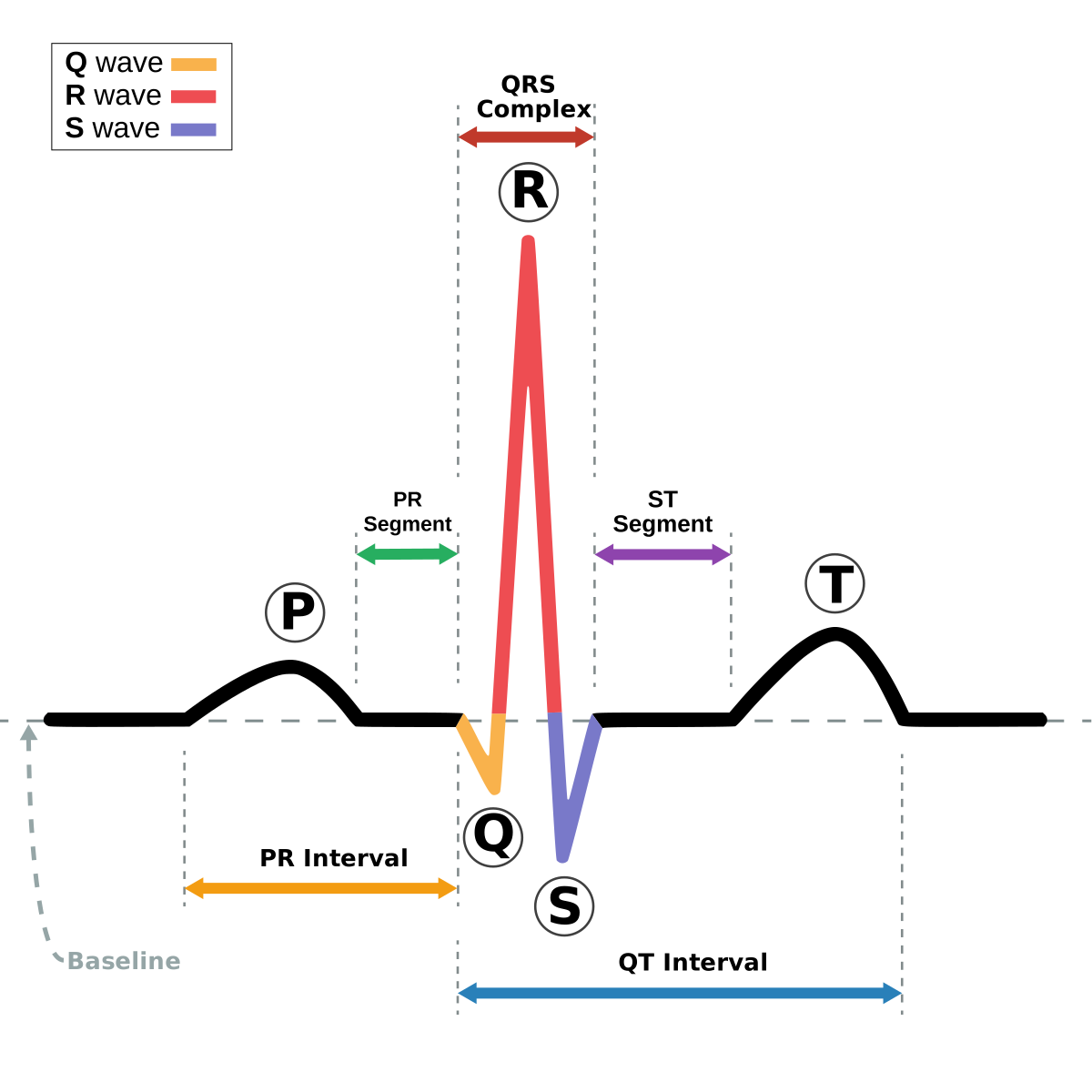
Is there a P-wave preceding every QRS complex?
Absent or dissociated P-waves suggest junctional rhythm, complete heart block, SVT, or VT. Urgent senior / cardiology review.
P-Waves
Is the P-wave amplitude less than 3 small boxes?
Tall P-waves (>3 small boxes / >0.25 mV) suggest right atrial hypertrophy (P pulmonale). Associated with pulmonary hypertension or right heart disease. Discuss with cardiology.
Axis
Is the QRS complex positive in both leads I and aVF?
Normal axis = positive in leads I and aVF.
Abnormal axis. Left axis deviation may indicate LBBB, LVH, or inferior MI pattern. Right axis deviation (after age 1) may indicate RVH, RBBB, or pulmonary disease. Discuss with senior / cardiology.
PR Interval
Is the PR interval more than 2 but less than 4 small boxes? (80–200 ms)
If shorter than 2 boxes: check for delta wave and broad QRS - possible WPW.
Short PR (<80 ms) with delta wave and broad QRS → consider WPW - urgent cardiology referral. Long PR (>200 ms) → consider 1st, 2nd, or 3rd degree heart block. Discuss with senior / cardiology.
QRS Interval
Are the QRS complexes less than 2 small boxes in duration? (<80 ms)
Broad QRS indicates bundle branch block, ventricular rhythm, accessory pathway (WPW), hyperkalaemia, or sodium channel toxicity. Discuss urgently with senior / cardiology.
QT Interval
Is the QTc less than 460 ms?
Corrected QT = QT ÷ √RR (Bazett). Use the QTc Calculator for full analysis.
Prolonged QTc ≥460 ms - risk of torsades de pointes and VF. Review drug chart, electrolytes, and family history. Use the QTc Calculator for full analysis. Discuss with senior / cardiology.
VH - V1
Is the R wave smaller than the S wave in V1?
Dominant R wave in V1 suggests right ventricular hypertrophy (RVH). Associated with pulmonary hypertension, pulmonary stenosis, ASD, or Ebstein's anomaly. Discuss with cardiology.
VH - V5/V6
Is there separation with no overlap between the R-wave of V6 and the S-wave of V5?
Overlap between R(V6) and S(V5) may indicate biventricular or left ventricular hypertrophy. Discuss with cardiology.
Q-Waves
Are the Q-waves less than 4 small boxes deep in all leads?
Deep Q-waves (>4 mm) may suggest hypertrophic cardiomyopathy (HOCM), myocardial infarction pattern, or infiltrative disease. Important finding in a child - discuss with cardiology.
T-Waves V5/V6
Are the T-waves positive in V5 and V6?
T-wave inversion in V5/V6 is abnormal at any age. Consider LVH with strain, myocarditis, or ischaemia. Discuss with cardiology.
T-Wave V1
In patients <8 years, is the T-wave negative in V1?
A negative T-wave in V1 is normal in children under 8. After age 8 the T-wave in V1 should become upright.
Positive T-wave in V1 in a child under 8 years is abnormal. Consider RVH or posterior ischaemic pattern. Discuss with cardiology.
ST Segment
If ST elevation is present: is it raised by less than 2 small boxes?
If there is no ST elevation at all, answer YES.
Significant ST elevation ≥2 boxes may indicate myocarditis, pericarditis, Kawasaki disease, or ischaemia. Urgent senior / cardiology review required.